How We Built Social Watch, Our Own Social Listening and Competitor Tool
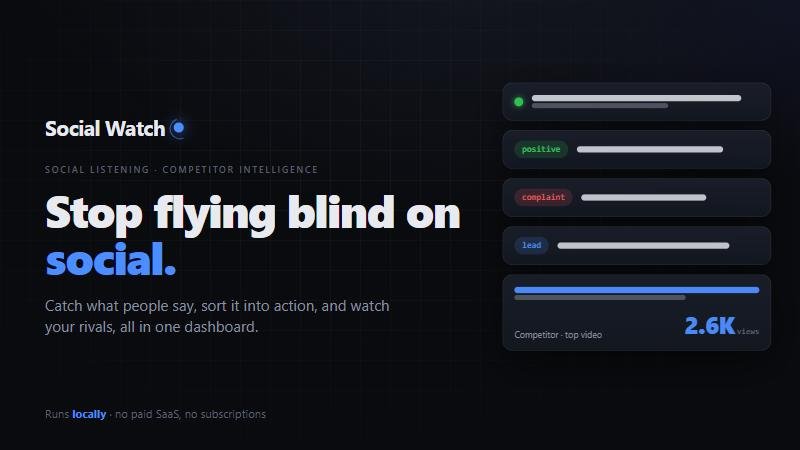
Every brand has a blind spot. While your team is shipping posts, planning campaigns and answering DMs, your customers are talking about you somewhere you aren't looking. A comment under a reel. A review on a directory nobody checks. A question sitting under a competitor's ad. And at the same time, your rivals are posting, testing and quietly learning what works. Most of us only find out weeks later, after a complaint has already spread or a competitor's format has already won.
We got tired of that. So we built something to fix it, a small tool we call Social Watch. It keeps track of what people say about our products, turns that feedback into clear next steps, and shows us what our competitors are doing on social media. All of it sits in one dashboard. And here is the part we are oddly proud of: we built it in house, it runs on a normal machine, and it does not need an expensive social listening platform or a stack of monthly subscriptions.
Here is what it does, how it works, and what it actually taught us.
The real problem
If you run a brand today, your customer conversations are spread across a dozen places. Facebook comments and reels. YouTube. App store reviews. Directories like G2 and SourceForge. The odd Reddit thread or blog post. Watching all of that by hand is a part time job nobody has time for, so most teams fall into three habits, and all three hurt.
The first habit is only checking your own page, which means you miss everything said anywhere else. The second is skimming comments instead of recording them, so real complaints, leads and bits of praise slip past unnoticed. The third is guessing about competitors instead of actually knowing which of their posts worked.
The usual fix for this is a social listening platform. Those tools are good, but they are priced for big enterprises and they do far more than a focused team needs. We wanted something smaller and sharper. Catch the signal, sort it, and tell us what to do about it.
What Social Watch does
The tool is built around four jobs. Each one takes noise and turns it into a decision you can act on.
It listens first. It gathers comments and mentions about our products, both from our own Facebook page and from across the public web, and puts them in one view. Instead of ten open tabs, there is one place that answers a simple question: who is talking, and where.
Then it sorts that feedback into action. Raw comments are useless until someone organizes them, so the tool reads every page comment and files it as positive, a complaint, a lead, or spam, and then suggests what to do next. A complaint about overtime pay becomes a comment to reply to and a setting worth checking. A run of "demo please" and "interested" comments becomes a follow up list for sales. A wall of course adverts becomes a one click clean up. Praise becomes proof you can collect as reviews later.
The third job is the one most teams never get around to. Social Watch pulls our competitors' top Facebook and YouTube content and ranks it by engagement, with links. Not a vague "they posted something" but a concrete "this video got 2.6K views and 27 reactions, that one flopped." You can see at a glance which rivals are active, which are asleep, and which formats are winning.
The last job is staying out of your way. The tool runs on its own every hour and refreshes the data. It exports a clean CSV report when you want one. And adding a new product or a new competitor is as easy as updating a knowledge base, with no rebuild.
The whole thing lives in a single local dashboard. There is no login wall, no seat fee, and nothing leaves the machine unless we send it.
How it works under the hood
Honestly, the design is boring, and that is a compliment. It is a small local web app plus an hourly script.
We feed it a knowledge base: what each product is, who it is for, and who the competitors are. We can sync that straight from a GitHub repository or upload it as a zip. That is what makes it flexible. Swap the knowledge base and the same tool now watches a different product against a different set of rivals.
For data, we lean on official sources wherever we can. Our own Facebook page comes in through the Graph API with a long lived token, so comments and engagement arrive reliably. Competitor YouTube comes from the YouTube Data API, which happily returns any public channel's videos with view, like and comment counts. For mentions on the wider web, we use search. Competitor Facebook is the hard one, because there is simply no public API for pages you do not manage, so we do a careful logged in browser pass and read what is public: follower counts, ratings, and top videos by views.
Every hour a small script wakes up, reads the knowledge base and settings, pulls the latest comments and competitor data, sorts and scores everything, writes the results, and emails us if anything new showed up. The dashboard just reads those results. The part that needs judgment, reading a comment and deciding whether it is a complaint, a lead or spam, and then recommending what to do, is where the tool earns its place, instead of leaning on a crude set of keyword rules.
We are also upfront about what it cannot do, because that is part of trusting it. Real time to the second is not realistic without webhooks and an always on server, but "checked every hour and emailed shortly after" is. Catching literally everything said about us everywhere is not possible either, so we catch what is public and indexed, plus our own page. And competitor Facebook data stays best effort, because Meta does not hand out an API for other people's pages. Saying all of that out loud is why we trust the output. It reports what it found, not what it wishes it had found.
What it actually taught us
The moment it earned its keep was the moment a vague feeling turned into a specific fact.
Take one example. On Facebook video, across all of our HR software competitors, exactly one was genuinely active. It ran a steady stream of short product videos pulling between 1.6K and 2.6K views each. The rest were weak. One posted only holiday greetings with no product content at all. Another had been quiet for years. A third had no videos whatsoever, yet its following was nearly double ours. That is no longer a hunch, it is a map. It shows us where the pressure is and, just as usefully, where the open space is. Facebook video is a lane most of our rivals are not even trying to run in.
On the listening side, the biggest win was not the praise. It was one complaint buried in a flood of comments. A real user flagged that a certain kind of urgent overtime work was not being paid out properly. That single comment, surfaced and labelled, was worth more than a hundred generic "nice" replies, because it pointed straight at a fix and at a reply that protects trust.
There was a quieter lesson too. For a focused B2B product, most of the "where are people talking about us" question resolves to a short list: your own page, the app stores, and a handful of directories. You do not need to boil the ocean. You need to catch the few places that matter, and act before the moment passes.
Why we kept it small and local
We did not want to stand up an enterprise platform or pay for a stack of tools to solve one focused problem. So Social Watch handles the parts that take judgment, reading comments, sorting feedback, writing the recommendation, pulling and ranking competitor content, and keeps the plumbing around it, the dashboard, the scheduler, the CSV export, as plain local code. The result is cheap to run, easy to change, and completely ours.
Keeping it that lean is what turned a nice idea into something that genuinely runs every hour and drops useful alerts into our inbox.
The point
You do not need a big budget to stop flying blind. You need to catch what your customers say, sort it into action, and know what your competitors are doing, and you need all of that to run without you babysitting it.
That is what Social Watch does. It listens to your customers and watches your competitors, and then it tells you what to do next.
If you are drowning in scattered comments, guessing about your rivals, and reacting a week too late, there is a better way, and it does not take an enterprise contract. Sometimes the smartest tool is the one you build to fit the exact blind spot you have.
Want to see it, or build one for your own brand? Message us at shuvogt.com, or on WhatsApp at +880 1679 351009.